

4 Employer Branding Strategies That Actually Work: Workshop Findings from 80+ Talent Professionals
We found that Employer Branding advice often hides behind “budget” 😏. But we knew we could make it better and with 0€.
That’s why our MisterSpex sponsored event ran:
- 1 full presentation from Rap Paulavicius which he made available to us in full
- 4 X 60 Mins workshops discussing 4 Employer Branding themes.
We came back with a huge playbook this Month, we make this available for free, knowledge crowdsourced from nearly 80 people.
If you try, test, implement, win…with any of these strategies, please let us know.
One of our main goals with this Playbook is to be useful.
Workshop: How to Turn Employees into Brand Ambassadors
Facilitated by Marlen
The Challenge
Most companies sit on their most powerful recruitment asset: their own employees. Yet the majority of staff won’t share company content or refer candidates, leaving talent teams to do all the heavy lifting alone.
The Reality Check:
- Company commitment issues: employees don’t connect with the product or broader mission
- The “why become a brand ambassador” question remains unanswered
- Time constraints and content creation barriers
- Fear of stepping outside comfort zones on personal social channels
- Lack of clear guidance and structured programmes
What We Discovered
Our participants identified the core barriers preventing employee advocacy:
Psychological Barriers:
- Employees don’t see employer branding as their responsibility
- Fear of getting outside their comfort zone on social media
- Anxiety about engagement and potential negative feedback
- Misalignment between company values and personal brand
- Lack of understanding about their role in the recruitment lifecycle
Practical Barriers:
- No idea how to create compelling content
- Time-consuming processes with no clear guidelines
- Unclear expectations and capacity concerns
- Quality concerns about self-generated content
- Absence of proper tools and templates
Organisational Barriers:
- Introverted employees feel left out
- Business understanding gaps affect authentic messaging
- Language and cultural aspects don’t translate to company messaging
- Lack of recognition and incentive structures
The Solution Toolkit
1. Foundation: Start Small, Think Big
Begin with the motivated:
- Identify employees already contributing and engaged
- Use leverage: make these early adopters your amplifiers
- Focus on organic growth rather than forced participation
Key Insight: “Start small with the motivated group and leverage (make them shine) → organic growth”
2. 💡The CLEAR Framework
- Consistency – Work consistently, dedicate time
- Long-term – Focus on sustained engagement, not quick wins
- Employee-first – Prioritise what employees need to succeed
- Accessible – Make participation effortless
- Recognition – Celebrate contributions consistently
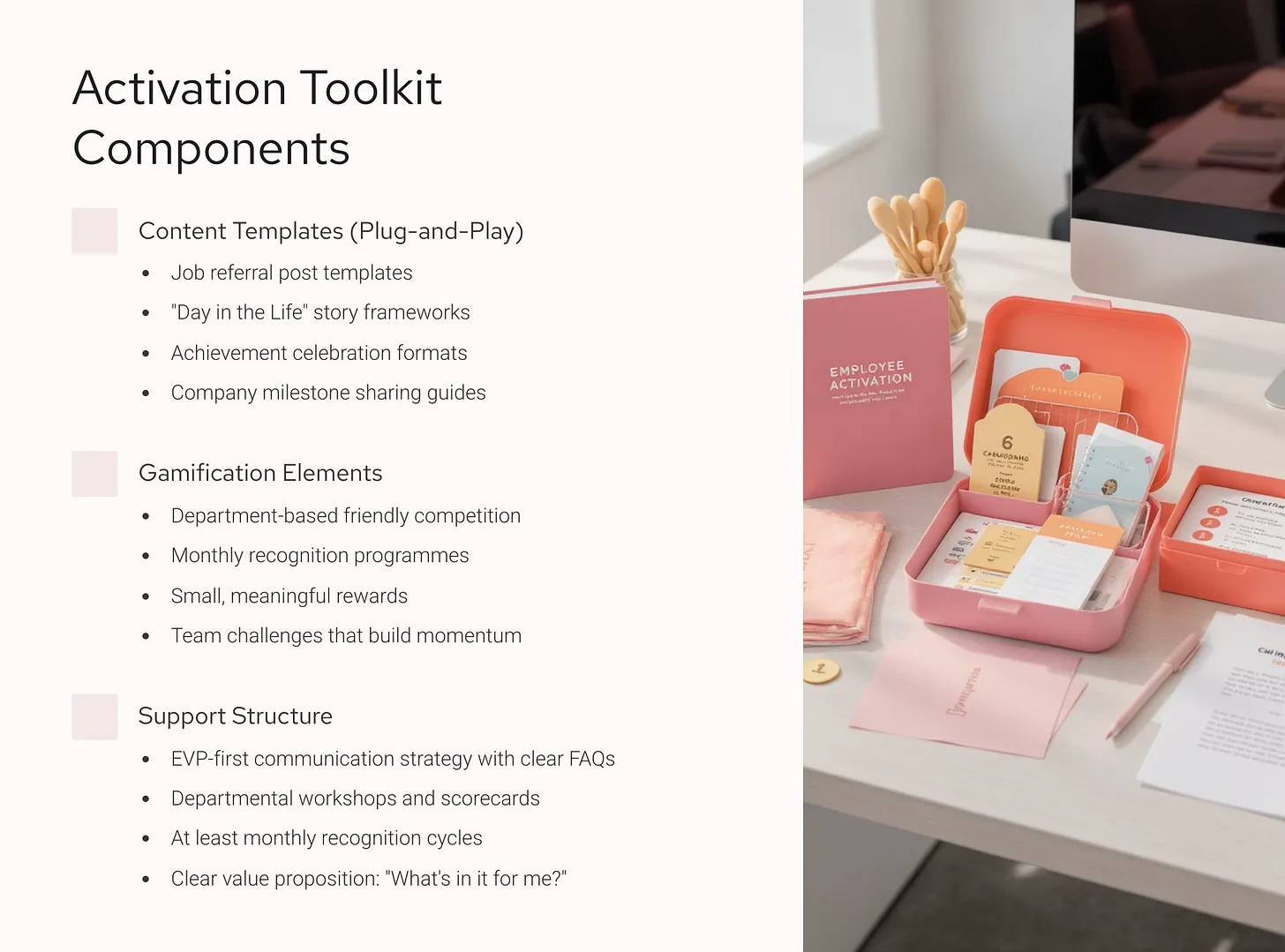
3. Activation Toolkit Components
4. Implementation Strategy
Phase 1: Foundation Building
- Leverage already invested people who are actively contributing
- Establish the “why” and “how” with clear mission alignment
- Create intrinsic motivation by connecting individual roles to company contribution
Phase 2: Programme Rollout
- Implement structured workshops in departments
- Provide community networking opportunities
- Launch branding calendar with freedom to explore and build personal brand
- Set up recognition systems with clear value exchange
Phase 3: Sustained Engagement
- Regular check-ins on learnings, failures, and successes
- Continuous programme iteration based on feedback
- Long-term incentive structures that maintain momentum
Workshop: How to Improve Kununu & Glassdoor Ratings Authentically
Facilitated by Benjamin
The Challenge
Poor employer ratings on Kununu and Glassdoor can kill your talent pipeline before it even starts. Most companies either ignore these platforms entirely or panic-respond to negative reviews, making the situation worse.
The Reality Check:
- We’re losing qualified talent because Kununu is only as important as the person applying makes it
- Kununu is not helping us understand what the company stakeholder changes depend on
- The question remains: how do we create authentic positive reviews without manipulation?
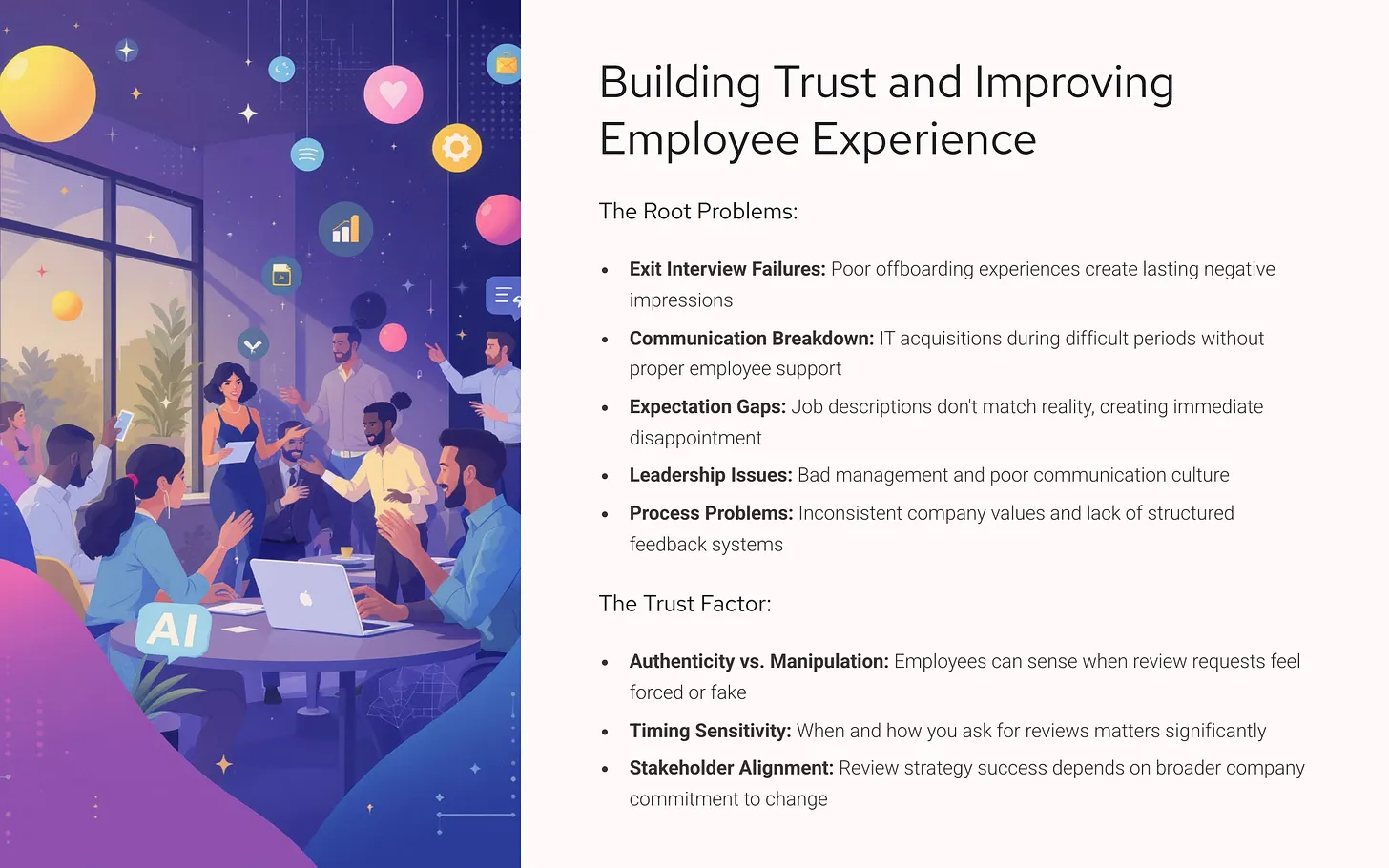
What We Discovered
The Solution Framework
1. Foundation: Fix Before You Ask
Ground Work First:
- Address root causes before soliciting reviews
- Ensure employee satisfaction matches what you want reviewed
- Create genuine positive experiences worth sharing
Key Insight: “You can’t polish poor employee experience into good reviews”
2. The SMOOTH Framework
- Smooth Exit Interviews – Transform offboarding into positive closure
- Manage Expectations – Align job descriptions with reality
- Open Communication – Create transparent feedback culture
- Outreach Strategy – Time review requests thoughtfully
- Top Performer Focus – Leverage satisfied employees strategically
- Honest Response Protocol – Address negative reviews authentically
3. Review Engagement Strategy
Timing Strategy:
- Sweet Spots: After positive milestones, successful projects, or recognition
- Avoid: During stressful periods, layoffs, or major changes
- Frequency: Quarterly campaigns rather than constant requests
Response Best Practices:
- For Negative Reviews: Acknowledge, don’t defend. Show specific improvements made
- For Positive Reviews: Thank genuinely, amplify key messages internally
- Transparency: Be honest about challenges while highlighting progress
Internal Advocacy:
- Leadership Training: Equip managers to create review-worthy experiences
- Recognition Strategy: Celebrate teams and individuals consistently
- Feedback Culture: Make it safe to share honest input internally first
4. Implementation Roadmap
Phase 1: Internal Cleanup (Month 1-2)
- Conduct honest internal review culture assessment
- Address major satisfaction gaps
- Train leadership on creating positive employee experiences
Phase 2: Strategic Outreach (Month 3-4)
- Launch thoughtful review request campaigns
- Implement response protocols for incoming reviews
- Create feedback loops between reviews and internal improvements
Phase 3: Sustained Engagement (Month 5+)
- Regular monitoring and response cadence
- Continuous improvement based on review themes
- Integration with broader employer branding efforts
Ready to Implement?
Start with an honest assessment of your current employee experience. If you wouldn’t enthusiastically review your own company, neither will your employees.
Workshop: How to Make Generic Benefits Stand Out
Facilitated by Diana
The Challenge
Company benefits fail to attract top talent because they are too generic or not effectively communicated. Most organisations offer similar perks but struggle to differentiate themselves in a crowded talent market where “great benefits” has become meaningless.
The Reality Check:
- Every company claims to offer excellent benefits, but messaging sounds identical
- Strongest perks aren’t positioned compellingly or communicated effectively
- Generic benefits like gym discounts feel outdated and irrelevant to modern talent
- Legal mandatory rights are presented as unique selling points
- True flexibility and meaningful perks get lost in checkbox messaging
- Lack of authentic employee voices and personalised communication
What We Discovered
Our participants identified why benefits communication fails and what makes offerings genuinely compelling:
The Positioning Problems:
- Out-dated Benefits: Gym memberships and standard perks feel irrelevant to modern workforce priorities
- Generic Messaging: “Flexible working” and “great benefits” lack specificity and authenticity
- Legal Minimums as Selling Points: Presenting mandatory rights as unique offerings
- Lack of Personalisation: One-size-fits-all communication doesn’t resonate
- Missing Employee Voice: Benefits lack credible testimonials and real-world examples
The Communication Barriers:
- Language Challenges: Difficulty translating benefit value into compelling copy
- Storytelling Gaps: Inability to create authentic narratives around benefits
- Channel Confusion: Unclear how to effectively communicate across platforms
- Relevance Issues: Benefits don’t align with target candidate priorities
- Proof Point Absence: Lack of concrete examples and employee testimonials
The Solution Framework
1. Foundation: Invest Where It Counts
Strategic Positioning:
- Focus resources on benefits that genuinely differentiate rather than generic offerings
- Identify unique aspects of standard benefits that competitors don’t offer
- Align benefit communication with actual employee needs and preferences
Key Insight: “We don’t have flashy perks. We invest where it counts.”
2. The CHOICE Framework
- Creative Messaging – Transform generic descriptions into compelling value propositions
- Humanised Storytelling – Use authentic employee experiences to demonstrate impact
- Outcome-Focused – Show results and real-world applications rather than features
- Interactive Communication – Create engaging, personalised benefit experiences
- Contextual Relevance – Tailor messaging to specific roles and candidate priorities
- Evidence-Based – Support claims with concrete examples and testimonials
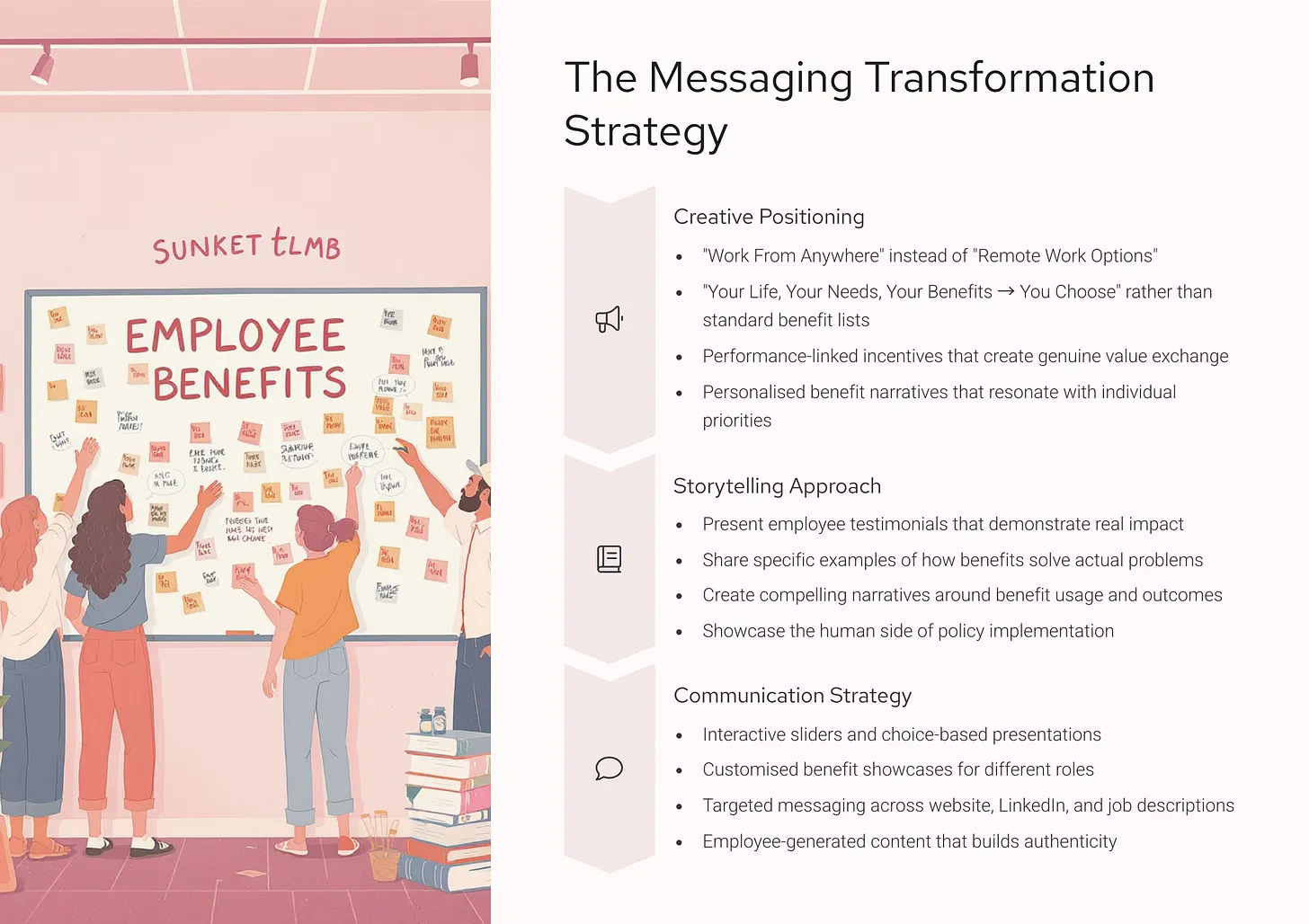
3. The Messaging Transformation Strategy
4. Implementation Roadmap
Phase 1: Benefit Audit and Positioning (Week 1-2)
- Assess current benefit offerings against competitor landscape
- Identify unique differentiators and authentic value propositions
- Develop creative messaging framework for priority benefits
Phase 2: Content Creation and Storytelling (Week 3-4)
- Gather authentic employee testimonials and success stories
- Create interactive benefit communication tools
- Develop role-specific benefit positioning strategies
Phase 3: Multi-Channel Integration (Week 5-6)
- Implement new messaging across all recruitment touchpoints
- Launch employee advocacy programme for benefit promotion
- Establish feedback loops for continuous messaging refinement
Ready to Transform Your Benefits Communication?
Start by auditing your current offerings against what your employees actually value. If your benefits don’t solve real problems or enhance genuine work-life integration, no amount of creative messaging will make them compelling.
Workshop: How to Get Hiring Managers to Engage on LinkedIn
Facilitated by Sebastian
The Challenge
Hiring managers are the most credible voices for your company culture and roles, yet most remain invisible on LinkedIn. Meanwhile, talent acquisition teams burn out trying to do all the employer branding heavy lifting alone, while the people who actually know the jobs stay silent.
The Reality Check:
- Hiring managers have authentic industry credibility that recruitment teams can’t replicate
- They’re already connected to top talent in their networks but aren’t leveraging these relationships
- Their absence from LinkedIn creates a gap between company messaging and actual team culture
- Recruitment teams are left to sell roles they don’t fully understand to candidates who want to hear from the actual decision-makers
What We Discovered
Our participants identified the real barriers keeping hiring managers off LinkedIn and what actually motivates them to engage:
The Resistance Factors:
- Time Poverty: “I have other priorities” is code for “this feels like extra work with unclear ROI”
- Content Anxiety: Fear of not knowing what to say or saying the wrong thing publicly
- Platform Intimidation: LinkedIn feels like a professional performance they’re not prepared for
- Ownership Confusion: Unclear whether employer branding is their responsibility or the recruitment team’s
- Lack of Recognition: No feedback loop showing how their posts impact hiring success
The Motivation Triggers:
- Visible Results: Seeing direct connections between their posts and quality candidate pipeline
- Peer Recognition: Being acknowledged by leadership and colleagues for their contribution
- Effortless Execution: Templates and systems that make posting feel like a 5-minute task
- Competitive Element: Friendly competition with other hiring managers or departments
- Personal Brand Building: Understanding how LinkedIn activity enhances their own professional reputation
The Solution Framework
1. Foundation: Make It About Them, Not You
Personal Value Proposition:
- Position LinkedIn activity as professional development, not recruitment support
- Highlight how thought leadership builds their industry reputation
- Connect their posts to career advancement opportunities
- Show how sharing insights positions them as industry experts
Key Insight: “Hiring managers post when they see personal benefit, not just company benefit”
2. The SIMPLE Framework
- Support-First – Provide all tools and templates before asking for participation
- Incentivise – Create recognition and competitive elements that drive engagement
- Minimise – Reduce posting to 5-minute monthly commitments
- Personalise – Tailor content suggestions to their specific expertise and interests
- Link – Connect their activity directly to hiring outcomes and success metrics
- Enable – Give them authority to share authentic insights without approval processes
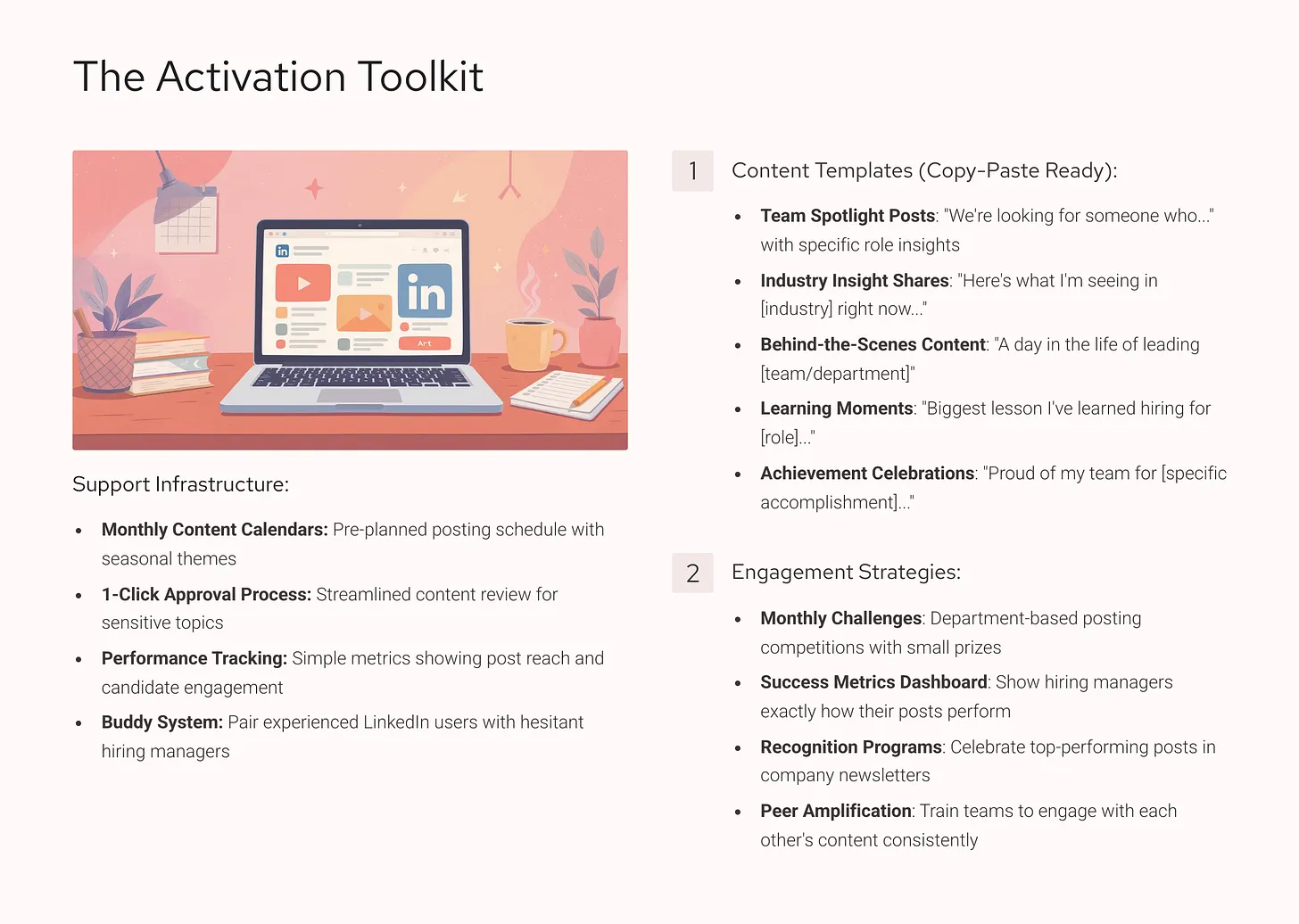
3. The Activation Toolkit
4. Implementation Roadmap
Phase 1: Foundation Building (Month 1)
- Identify willing early adopters among hiring managers
- Create personalized value propositions for each participant
- Develop role-specific content template libraries
- Set up tracking systems for measuring impact
Phase 2: Pilot Program Launch (Month 2-3)
- Launch with 3-5 motivated hiring managers
- Implement monthly content calendar system
- Begin recognition and competitive elements
- Gather feedback and refine processes
Phase 3: Scaled Rollout (Month 4-6)
- Expand to additional hiring managers based on early success
- Create case studies from pilot program results
- Implement peer-to-peer training systems
- Establish long-term recognition and incentive programs
Ready to Activate Your Hiring Managers?
Start by identifying your most LinkedIn-active hiring managers and asking them what would make posting effortless for them. If they’re already posting occasionally, they’re your early adopters. Give them better tools, recognition, and success metrics. Let their enthusiasm and results convince the skeptics naturally.